

Family Offices are undergoing a quiet but significant evolution. Traditionally, many were built around the vision and decision-making of a single founder, often operating with informal structures and limited governance. Today, however, we are seeing a clear shift towards more mature and professionalised models.
This transition is being driven by several factors. As family wealth grows, so too does the complexity of managing it, across asset classes, jurisdictions, and regulatory environments. At the same time, multi-generational involvement introduces new perspectives, expectations, and at times, competing priorities. Alongside this, there is increasing demand for transparency, accountability, and robust governance.
In our experience, this move towards maturity should not be seen as a shift towards being overly corporate. Rather, it represents a natural and necessary stage in the evolution of successful Family Offices, one that reflects their growing scale, complexity, and long-term ambitions.
What “Maturing” looks like in practice
A more mature Family Office is not defined by size alone, but by how it operates. We found that several key characteristics tend to emerge as structures evolve:
- Defined governance frameworks that clarify roles, responsibilities, and oversight
- Clear decision-making structures that reduce ambiguity and improve efficiency
- Specialised roles and functional expertise, often bringing in professionals across investment, legal, tax, and operations
- Formalised investment processes, including structured due diligence, portfolio construction, and performance monitoring
- Greater operational discipline, supported by systems, reporting, and controls
In practice, this level of maturity enables more consistent decision-making, strengthens resilience, and ensures the Family Office can operate effectively regardless of individual involvement.
The stages of Family Office development
Family Offices do not evolve overnight, nor do they follow a perfectly linear path. Instead, maturity develops progressively over time.
The Agreus Family Office Maturity Model provides a structured way to understand this progression, helping families assess their current position and define a clear path forward.
Stage 1: Embedded
Informal, founder-led, and sit inside the operating business. Small teams, limited governance, and heavy reliance on external advisers.
Stage 2: Early-Stage
The Family Office becomes a standalone entity, and the family introduces internal support through hires or advisers. Early structures and reporting begin to take shape, though decision-making remains centralised.
Stage 3: Developed
Roles become clearer and responsibilities are shared. More core functions start to move in-house, with more consistent processes and reporting.
Stage 4: Professionalised
Governance frameworks, specialist roles, and formal processes are established. Teams began to expand. Decision-making is more structured and less dependent on individuals.
Stage 5: Mature
A fully mature, resilient model with strong governance, scalable infrastructure, and long-term, multi-generational focus.
What distinguishes the Agreus Family Office Maturity Model is its practical application. It not only defines these stages but helps Family Offices identify where they sit today, benchmark against peers, and prioritise development across governance, talent, operations, and investment management. This enables a more structured and intentional progression, ensuring that growth in complexity is matched by growth in capability.
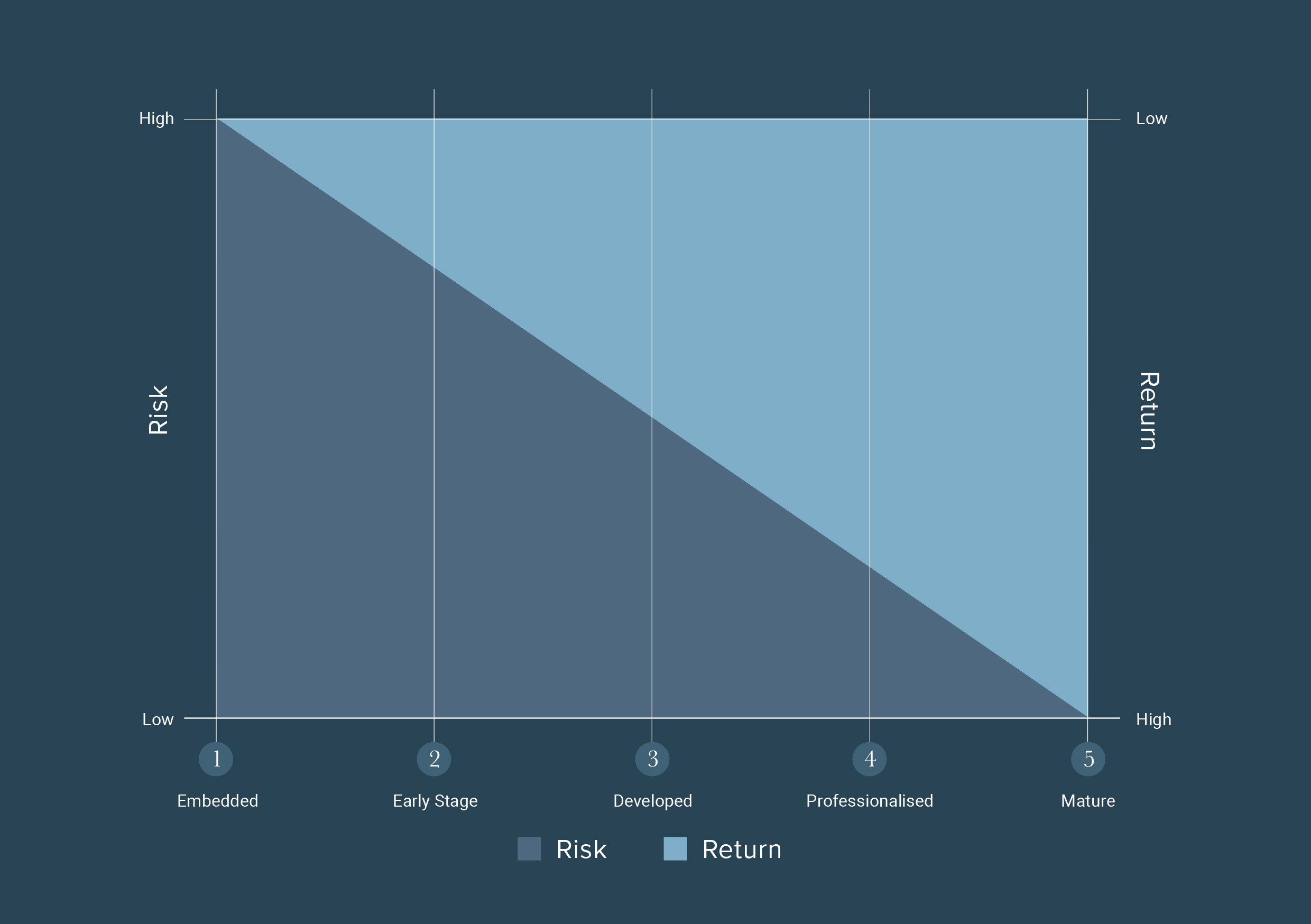
Ultimately, maturity provides the foundation for long-term sustainability. It enables Family Offices to preserve and grow wealth while maintaining alignment with family values and long-term objectives.
Maturity in a Family Office is not about becoming more corporate. It is about building the clarity, structure, and resilience needed to manage increasing complexity and ensure long-term success.
As Family Offices continue to grow and evolve, taking the time to assess current structures and plan for future development becomes increasingly important. Those that embrace this progression are better positioned to navigate change, support future generations, and sustain their legacy over time.
At Agreus we work closely with Family Offices to support this journey, from structured assessments, through to tailored recruitment plans, and hands-on support to implement change effectively and sustainably. To understand where your Family Office sits on the maturity curve, speak to Agreus about how we can support your next stage of development.