

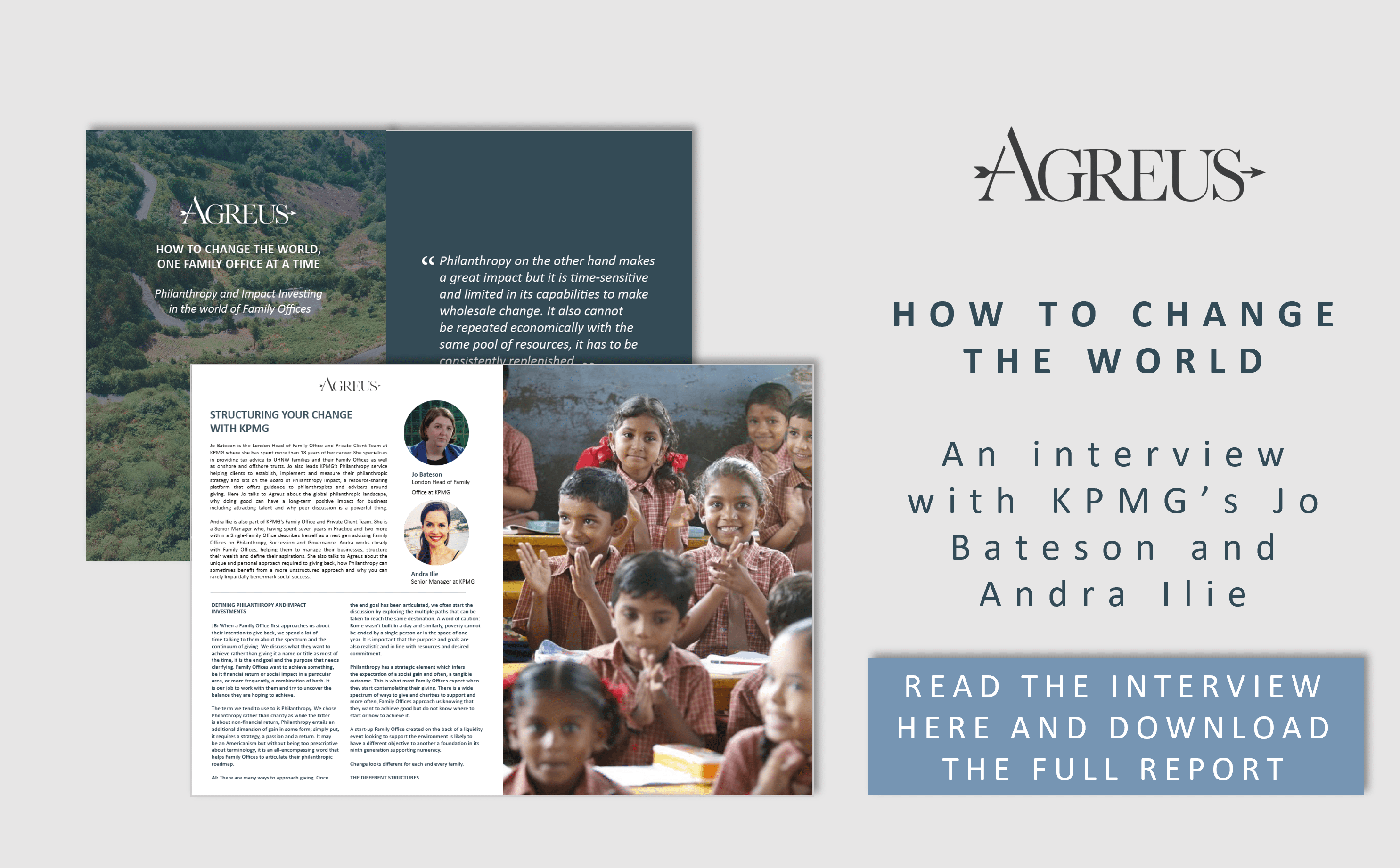
This is an extract from the 2021 Philanthropy And Impact Investing In The World Of Family Offices Report. Download the full report here.
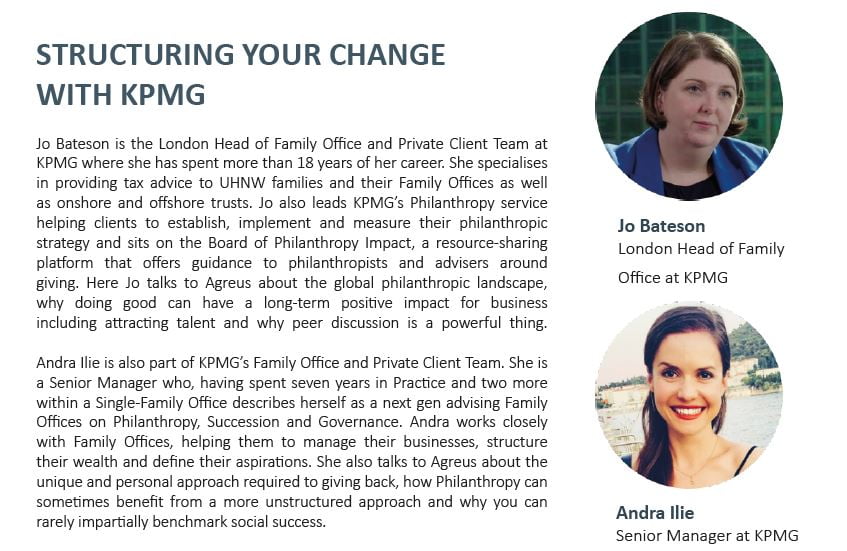
DEFINING PHILANTHROPY AND IMPACT INVESTMENTS
JB: When a Family Office first approaches us about their intention to give back, we spend a lot of time talking to them about the spectrum and the continuum of giving. We discuss what they want to achieve rather than giving it a name or title as most of the time, it is the end goal and the purpose that needs clarifying. Family Offices want to achieve something, be it financial return or social impact in a particular area, or more frequently, a combination of both. It is our job to work with them and try to uncover the balance they are hoping to achieve.
The term we tend to use to is Philanthropy. We chose Philanthropy rather than charity as while the latter is about non-financial return, Philanthropy entails an additional dimension of gain in some form; simply put, it requires a strategy, a passion and a return. It may be an Americanism but without being too prescriptive about terminology, it is an all-encompassing word that helps Family Offices to articulate their philanthropic roadmap.
AI: There are many ways to approach giving. Once the end goal has been articulated, we often start the discussion by exploring the multiple paths that can be taken to reach the same destination. A word of caution: Rome wasn’t built in a day and similarly, poverty cannot be ended by a single person or in the space of one year. It is important that the purpose and goals are also realistic and in line with resources and desired commitment.
Philanthropy has a strategic element which infers the expectation of a social gain and often, a tangible outcome. This is what most Family Offices expect when they start contemplating their giving. There is a wide spectrum of ways to give and charities to support and more often, Family Offices approach us knowing that they want to achieve good but do not know where to start or how to achieve it.
A start-up Family Office created on the back of a liquidity event looking to support the environment is likely to have a different objective to another a foundation in its ninth generation supporting numeracy.
Change looks different for each and every family.
THE DIFFERENT STRUCTURES
JB: First on the spectrum and perhaps most widely known, is cash-giving. For families that want to give small (or large) amounts to specific causes, the first step should be looking at the charities and foundations that already exist to assess whether any are in line with their wishes. From sponsoring a marathon runner supporting a charity for loneliness to becoming a large donor for a medical research charity, there are myriad options out there – 185,000 main and linked charities as of October 2021.
There can be substantial costs and risks associated with structuring your own foundation so navigating your way to founding a charity should not be entered into lightly. It can be expensive, challenging and requires significant administrative handling alongside compliance with regulatory bodies. Running your own charitable foundation also requires resources, both in terms of finances, time and talent.
If running one’s own projects, wishing to create a legacy, or perhaps using the foundation as an interface for engaging the next generation are elements of the family’s philanthropic purpose, setting up a charity may well be the right answer.
For other families who want to tangibly create something from scratch and be involved in the process while lacking time, they can consider structures such at Donor Advised Funds. These are used frequently in place of a foundation. They require less administrative work and can be popular for dual-registered citizens, such as those who live in both in the UK and USA as they allow relief in both jurisdictions.
For other families, they may turn to the Impact Investing model which can work alongside existing investment portfolios to create both social and financial returns. Often, a blend of all the options tends to work well.
AI: It is important to note that a lot of unstructured giving also exists and it can be the right option in many circumstances. Some families have a Family Council that carry out specialist charity projects within their communities and beyond. While they do not have a particular legal structure, they can still take part in incubator programmes and support entrepreneurs on a time and mentorship basis, while allowing the next generation family members to get involved. Giving is not always about parting with finances and it does not always require a complicated framework. Often Philanthropy can be highly impactful by sharing knowledge and expertise to help build future self-sustaining projects.
THE GLOBAL CHALLENGE
JB: One of the challenges we face in the philanthropic space today is the lack of a global framework for giving and it is something that can impact more established Family Offices on their journey towards effecting change.
There is no one-size-fits-all-approach to international Philanthropy or global social change. One needs to separate each structure into geographies, regulations, regimes, taxation, cultures and attitudes. There are little pointers within the regulations of each country that illustrate the way in which they think is the best way to give. Some impose it, others condone it – for example, the state-imposed church tax in some Northern European countries versus the tax relief on direct and corporate giving in countries in North America and across Western and Eastern Europe. It is a challenge for the future and an immediate challenge for Family Offices looking to make significant change in different parts of the world.
Choosing a jurisdiction for your philanthropic structure is determined by several factors, mostly linked to the key donors’ residence and location of projects and teams, however it tends to be established in one place and therefore allows tax relief under that jurisdiction’s terms. Where projects are carried out in multiple countries, to obtain “charitable status” and benefit from the relevant relief, a local domestic structure also needs to be established thus adding to the costs of the infrastructure. It would be beneficial to have a global marketplace as it would broaden the capability of making impactful change. Some of the recent research seems to point towards countries such as the UK or Canada acting as potential hubs for global Philanthropy.
DOING GOOD IS BECOMING A REQUIREMENT FOR BUSINESS
JB: In many sectors and industries nowadays, offering a strong Corporate Social Responsibility programme alongside aligned governance policies has almost become a requirement for businesses. Even more, some have decided to go down the route of obtaining a B Corporation certification, a hallmark for how the organisation looks after the environment, their employees and local community by reference to a scorecard. It can offer businesses a competitive edge but it is not a new phenomenon. There are Family Offices, particularly those that are still linked to Family Businesses, that have been promoting change for decades. They are already heavily involved in their community and its initiatives but are just not reporting it as it stems from a more altruistic desire to give back.
POST PANDEMIC TRENDS
JB: I have recently seen a lot more collaboration between Family Offices and individual philanthropists, which has been accelerated by the pandemic and the urgent need for taking a stand amid a global crisis. It has made some philanthropists think harder about whether they need their own structures, or whether working with existing charities or infrastructures set up for these purposes might be best. Co-giving and co-helping have emerged as strong trends.
AI: For me, the biggest change has been around recognising the need for flexibility. We have seen headlines around flexible working and flexible living, as well as trends towards flexible and hybrid giving, which is a refreshing change. When you are not being tied to a particular structure, it means that whatever way you chose to give back, you can do it flexibly and you can be nimble. Prime examples include projects to aid with natural disasters or indeed the effects of the pandemic itself. This is why co-giving and networks of philanthropists have been coming together, pooling financial and intellectual resources to create self-sustainable platforms for the future.
ADVICE TO FAMILY OFFICES
JB: Define your purpose, your objectives and your ambitions and then think carefully about the impact you want to have. Once you have your objectives and motivations outlined, speak to other Family Offices and networks of philanthropists. We always arrange for our Family Office clients to speak to those who have been on the same journey who are perhaps a little further along. While we advise on the structures and regulatory frameworks, there is no substitute for peer discussions. These conversations can be very powerful and so we advise any novice philanthropist to speak to another to learn from their victories and mistakes.
Another important point is around not rushing as you may miss some of the nuances along the way. Articulating your philanthropic strategy and roadmap will take time. In fact, it usually takes between six months and a year for families to come together and outline a long-term strategy. Learn from peers, be patient and ensure you create something that is fit for the future and its stakeholders.
AI: My advice is to research, research, research. When you establish your business and create a strategy you commit countless hours to crafting a business plan, strategizing and thinking of the best and most effective ways to bring your vision to life. You need to do the same for your philanthropic goals by establishing and articulating from the outset what you want to achieve, who is going to be involved, what roles they will each hold and how your strategy will come alive. Making sure everyone is aligned and the vision is communicated before you even start researching the best options is paramount.
MEASURING SUCCESS
AI: How to measure the success of social investments is one of the most-talked about topics within Philanthropy. While no-one ever likes this answer, it really does depend. Impact measurement differs on a cause-by-cause basis and for some, KPIs are easier to articulate, while for others, tangible or quantifiable metrics are harder to define. While there is basic reporting for most Philanthropy, in my experience astute Family Offices are seeking to import benchmarks from their business world and apply them to Philanthropy. This may work in certain areas but not for all and not everyone is keen on measuring either.
While some say having robust and clear KPIs is the only way to sustainably make an investment as you can quantify its success in a mathematical way, others believe it is at odds with the altruistic way of giving that is Philanthropy. While you can certainly measure the successful performance of an asset by reference to similar ones in its class, you cannot measure impartially the spectrum of change as social impact for one individual may not go far enough for another.
You can benchmark numbers, quantify levels of change, but impact cannot be benchmarked as it is both as personal and versatile as the Family Office and the people it requires to drive change.