

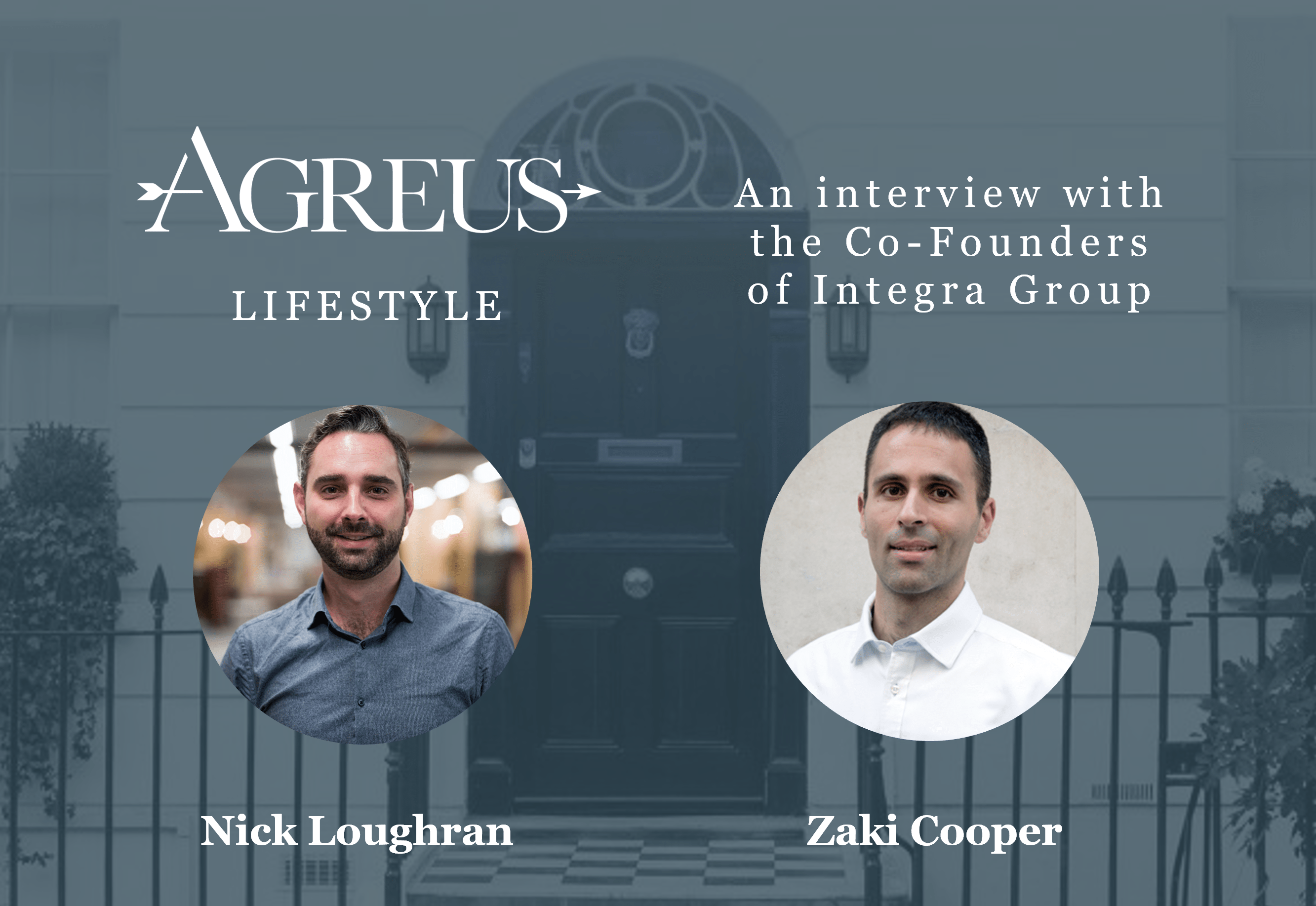
Integra is a Strategic Communications, Reputation and Social Impact Consultancy which works with the UHNW and Family Office Community. Founders Nick Loughran and Zaki Cooper joined forces to set up Integra in January 2021 after 20 years' of working with Royal, religious, business and political leaders and now use their experience to help Family Offices across the world. Nick and Zaki met in the Press Office at Buckingham Palace in 2009 having both served the Royal Household for a number of years. It was here the pair found the value of singular subject-matter expertise, taking a long-view and the power of imagery, three of many things they took with them to Integra.
In this Lifestyle Interview, Nick and Zaki offer their take on why reputation is a vital component of a Family Office’s identity, why creating a legacy should be top of your agenda and why it is important to stay relevant.
In a sentence or two, can you describe what service you offer to the Family Office community at Integra?
Nick: We’re a strategic communications, reputation and social impact consultancy and we work with a mixture of clients that are either social impact entrepreneurs within the Family Office or within their businesses which are of course intrinsically linked to the Family Office.
We offer three main groups of work. Communications is our main pillar, which involves communications strategy, implementation and reputation management – all things proactive and reactive communications. The second is Impact. We help shape the causes and issues close to our clients through their private foundations or philanthropic interests, while the third group of work is networks. This draws on our extensive connections and ensures our clients are well plugged into the people and the places they should be. Naturally, due to the success of their businesses, Family Office Principals typically boast their own networks but there are always gaps and, in the softest sense of the word public affairs, we are making sure the right people, in government and other sectors, are aware of our clients’ work.
Can you paint a picture of when a Family Office might turn to Integra for help?
Zaki: There are a number of different scenarios where we work with Family Offices.
The most common scenario is when a family is in crisis mode, whether that is personally, professionally or commercially. Another instance may be early on in their setting up of a Family Office; these individuals have been very focused on a singular enterprise for a long period of time and now, in their quest to diversify require support. We also get asked to help families growing their business. As we all know, communications can affect sales revenues and profits. Some financial institutions are now even going to tag employee bonuses to the reputation of the company. Reputation is no longer a nice-to-have but a vital component of an organisation’s identity and Family Offices are not immune to this .
To offer just two more examples of where we help. We work a great deal with intergenerational families where one generation is thinking of handing over the reins to either their investment portfolio or the not-for-profit side of their Family Office. Finally, we help with legacy. Shakespeare talks of the seven ages of man. Every single person’s life is split into stages and there comes a time in every successful entrepreneur’s life where they think about their legacy. We help them to articulate their story, their impact and their legacy.
You spoke about reputation being a vital component of an organisation’s identity. How often do Family Offices require reputation management?
Nick: Reputation is one of the most important things for Principals and their families to consider. The challenge often comes when we try to explain the importance of a proactive communications strategy to Family Offices as it can often be perceived as blanket coverage in every national newspaper. What a proactive communications strategy actually means is a back-up plan. A shield to be used in the event of any future crises or issues that can derail a Family Office who, without a plan, will be starting on the backfoot.
A proactive communications plan builds a picture of a Principal and their objectives, ambitions and passions beyond simply the family business. This often goes against the traditional mantra in the UHNW world that if you do or say nothing, you’ll be being left alone. I don’t believe there’s a place for this mentality any longer. So much scrutiny is placed upon transparency today, across all sectors, and with Principals and their families often transcending multiple sectors, there is a high chance that at any point, that Family Office will be placed under immense scrutiny. So having a story to rely upon – a picture of the impact that family is making – is extremely important. It is not just important for Family Office Principals but for Leaders across the board. As they say, reputation arrives on foot but leaves on horseback and there will always be issues on the horizon which can be managed in isolation but much better dealt with if managed collectively as part of a proactive and cohesive plan.
Are you seeing a new generation of wealth, wanting a brand?
Nick: In general yes. We can of course make sweeping generalisations here but in short, there is a difference between generations. Millennials see merit in not sticking to their lane for their entire life. As communications professionals we say there is benefit in taking a risk when you are younger. By taking a risk we mean trying new things. Those willing to take a risk are more open to the idea of a proactive communications plan and in fact see the benefit for it. It always worries me when a client does not want to put a foot wrong, it is unnatural and will happen. It really is, pardon the cliche, about how you deal with it. Transparency and ownership are key today and so the generation of leaders who make their mistakes publicly and own them will perhaps fare well.
The next-generation also bring with them a more global outlook due to either friends, family, education or travel. They have either travelled more or have a more worldly outlook on the things that trouble the world and this supports the view and need for a global brand.
Reputation now aside, what are the biggest challenges that Family Offices face that you try to deal with?
Zaki: Each family is different but there are some recurring themes. The biggest problem perhaps is the fact that the principals we work with are incredibly driven and focused on a particular area and, as a consequence, tend to be time poor. On the other end of the spectrum, we also see a lot of our clients who want to solve everything. They are again driven, hands-on and problem solving but it means once more that they are thinly spread and sometimes lacking in strategic focus. This is where we often come in. When thinking about the Royal Family , you can see how successful the model has been over the years where each family member concentrates on their own area of expertise and then comes together for the greater good.
Other problems often include non-aligned thinking within the family itself. While we are far from family therapists, clear and coherent communications can help bridge a gap within the family, particularly within multi-generational families. Our clients are all wealth creators and range from the under 40 to over 70 mark. They are all at different stages of life and sometimes this leads to non-aligned thinking within a family, which requires our help and support.
How did working for the Royal Household shape your thoughts and approach to working with Family Offices?
Nick: Zaki and I met at Buckingham Palace in 2009 in the central press office. Zaki was there for three years working primarily on the Diamond Jubilee some 10 years ago now as we approach the Platinum Jubilee. I spent most of my time (2010 – 2016) at Kensington Palace working with the Duke and Duchess of Cambridge and Prince Harry. The Royal Family is considered as one Royal Household but they of course have their own teams within that.
Working at Kensington Palace was different to working at Buckingham Palace. I had different Principals of different ages with different outlooks. When I was there, one of the biggest parts of my job was supporting them as they worked out what role they wanted to play within the institution and the impact they wanted to make outside of that. The biggest difference was in the style they took on in royal work. They will, as members of the Royal Family, always need to be seen at certain events of national importance but they can make an impact in a variety of other ways. The Queen has done so through 70 years of steadfast service while the Prince of Wales has done so very successfully in a charitable entrepreneur type of way, especially through the Prince’s Trust. And the next generation have taken on a campaigning style, equally successfully. If you look at the biggest initiatives to have been created under that style, they have changed the conversation around mental health, climate initiatives, or the support we give to wounded servicemen and women.
The younger generation of the Royal Family have each taken a topic and then used their platform to convene as many of the right people and organisations as possible for a central goal. I offer this background as it was a new model and a very successful one and it is akin to many Family Offices today. Principals do not necessarily have the same platform or profile but the collaboration approach is really quite important when looking at their philanthropic work. With the next generation of Family Office Leader, there is a willingness to work with others on a wide range of initiatives, particularly around global issues where you understand you need others to make a difference and cannot do so alone. I took a lot of these learnings with me from Kensington Palace, mostly around the power of convening and collaboration – to see an issue so great that you struggle to see how to make a tangible impact. You then break it down, focus on one element to change for the better and crucially, consider how you can work with others to see great results.
Zaki: I worked with the Royal Household up to and including the Diamond Jubilee in 2012. A lot of the learning I took from that period inform our work today at Integra. The Royal Family is a special and unique institution and one of the key things you learn is to take a long view. As an institution, it has existed for hundreds of years. Queen Elizabeth II is the 40th Monarch since William the Conqueror came to the throne in 1066. What they don’t tend to do is get bound up in the hysteria of tomorrow’s headlines which politicians do. There is a lot to be said for that. As you get older you do take the long view and learn not get caught up in the here and now.
Another thing I took away is a range of media: broadcast, radio, TV, print, imagery and online. I have always been a writer and a reader, keen on the words of communication. Until I worked at the Royal Household, I under-appreciated the power of an image, moving and still pictures. As they say, a picture paints a thousand words and it could not be truer in this scenario.
Integra is described as a Passionate, innovative and trusted service. Is this the recipe for success in the Family Office world?
Zaki: Trust is the real starting point, the building block of every relationship. A problem we have in society as a whole is that trust has broken down, whether that is in politics and the MPs expenses scandal or business and the fallout from the financial crash. The Church, the media and many other parts of public life have suffered due to a reduction in the amount of trust we have for them. Clearly we try to build trust for our clients and then we try to build this outwards, helping them to strengthen relationships with the media, government, charities and other bodies of interest. Passion is also a really important ingredient. When you work with successful entrepreneurs, they started something from a blank sheet of paper, often from their garages or spare bedrooms. It is easy to look back 30 or 40 years later after tremendous success but the amount of struggle that comes with that is enormous. Many leaders come to the edge in many ways but it is often their enthusiasm and passion that gets them through. This is paired with innovation. We like to think creatively and our backgrounds enable us to do so. We look at things on a very wide canvas. We have experienced the Royal Family, business, the NGO, diplomatic, political and faith worlds. We are comfortable stepping into any of these arenas and applying them to multi-faceted Family Offices who need them.