

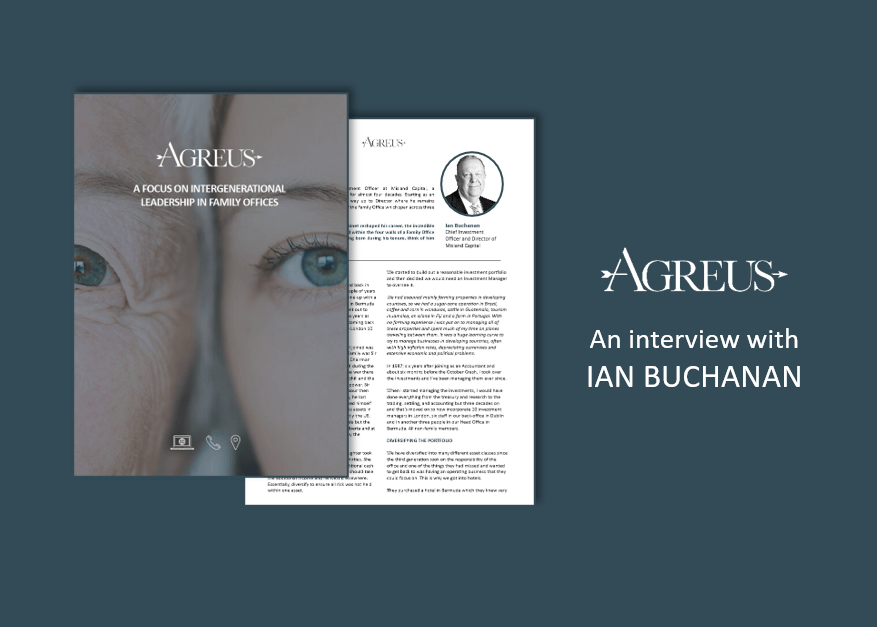
As part of our white paper focused on Intergenerational Leadership, we interviewed five Family Office leaders from three generations. This is just one of many extracts from the white paper which you can download, in full, here.
In this thought-leadership interview, we spoke to Ian Buchanan, the Chief Investment Officer at Misland Capital, a Family Office that he has worked for, for almost four decades. Starting as an Accountant in 1981 and working his way up to Director where he remains today, Ian has worked with five Heads of the Family Office which span across three generations.
Here he discusses how a Post-War cabinet reshaped his career, the incredible opportunities which can only be found within the four walls of a Family Office and how the youngest principals, being born during his tenure, think of him as family.
I qualified with Ernst & Young in Scotland back in 1980 and wanted to go abroad for a couple of years to experience life a little more. A job came up with a Family Office looking for an accountant in Bermuda in 1981 and so I applied and got it. I went out to Bermuda as an Accountant and didn’t end up coming back to the UK until we moved our offices to London 10 years ago.
The main business for the family when I joined was the coal business and the Head of the Family was Sir Harold Mitchell who had been the Vice Chairman of the Conservative Party here in the UK during the second-world war. Immediately after the war there was an election whereby Winston Churchill and the Conservatives lost, and Labour came to power. Sir Harold lost his seat as an MP and as Labour then went on to nationalise the coal industry, he lost his business too. He left the UK and based himself in Bermuda and built up coal, oil and gas assets in North America, Canada and subsequently the US.
The whole family were based in Bermuda, but the operations and coal business were in Alberta and at that time, any surplus cash generated by the business was reinvested into that area.
Sir Harold died in 1983 and his only daughter took over who at the time was in her early thirties. She decided that rather than invest this additional cash surplus back into the coal business, we should take the additional income and reinvest it elsewhere. Essentially, diversify to ensure all risk was not held within one asset.
We started to build out a reasonable investment portfolio and then decided we would need an Investment Manager to oversee it.
We had acquired mainly farming properties in developing countries, so we had a sugar-cane operation in Brazil, coffee and corn in Honduras, cattle in Guatemala, tourism in Jamaica, an island in Fiji and a farm in Portugal. With no farming experience I was put on to managing all of these properties and spent much of my time on planes travelling between them. It was a huge learning curve to try to manage businesses in developing countries, often with high inflation rates, depreciating currencies and extensive economic and political problems.
In 1987; six years after joining as an Accountant and about six months before the October Crash, I took over the investments and I’ve been managing them ever since.
When I started managing the investments, I would have done everything from the treasury and research to the trading, settling, and accounting but three decades on and that’s moved on to now incorporate 10 investment managers in London, six staff in our back-office in Dublin and in another three people in our Head Office in Bermuda. All non-family members.
Family Offices are very different, as I say, they are unlike the corporate world. What tends to happen is that while there are lots of talented people out there that a family could hire tomorrow, the individuals need to fit in with the family and the family needs to like them. If you put yourself in the shoes of a wealthy individual, you want someone who is good at their job, but also a person that you like and trust.
There are some unusual traits of the Family Office which may make it a difficult transition from a corporate environment but once a Family Office gets the right person, they want to keep them and the family will go out of their way to make that job secure, interesting, and financially attractive.
The biggest risk we face is staff turnover. What the Family has done for me, what I continue to do with my own Investment Team and what every leader should do with their next generation; family, or non-family, is to try and make the role interesting. I was largely thrown into things I had no experience of and often had to learn on my feet, especially when I was running the properties in developing countries. That was a huge learning experience for me. I was an Accountant from Glasgow and they sent me to Guatemala to manage a farm, I had no idea what I was doing but they expected me to learn.
When I started running investments, I don’t think I’d ever properly read the FT prior to that. The point is, the Family is very comfortable, when they have found someone, they think is good, putting them into environments where they have no experience. If you have common sense and you are smart you can largely do most things. If you are talented, families are willing to push you forward to represent them because they trust you to handle the project on their behalf.
Ian offers a unique insight into the incredible career path only available within the world of Family Offices. As an Accountant from Glasgow, he was able to travel the world, grow sugar-cane in Brazil, roast coffee beans in Honduras, wander across an Island in Fiji, and manage a farm in Portugal. Most importantly, Ian was able to become a valued member of the senior leadership team within six years and he remains today with a vast team, an incredible portfolio, and memories only imaginable within the world of Practice.
To discover your next adventure this year, please get in touch with a member of the Agreus Team.