

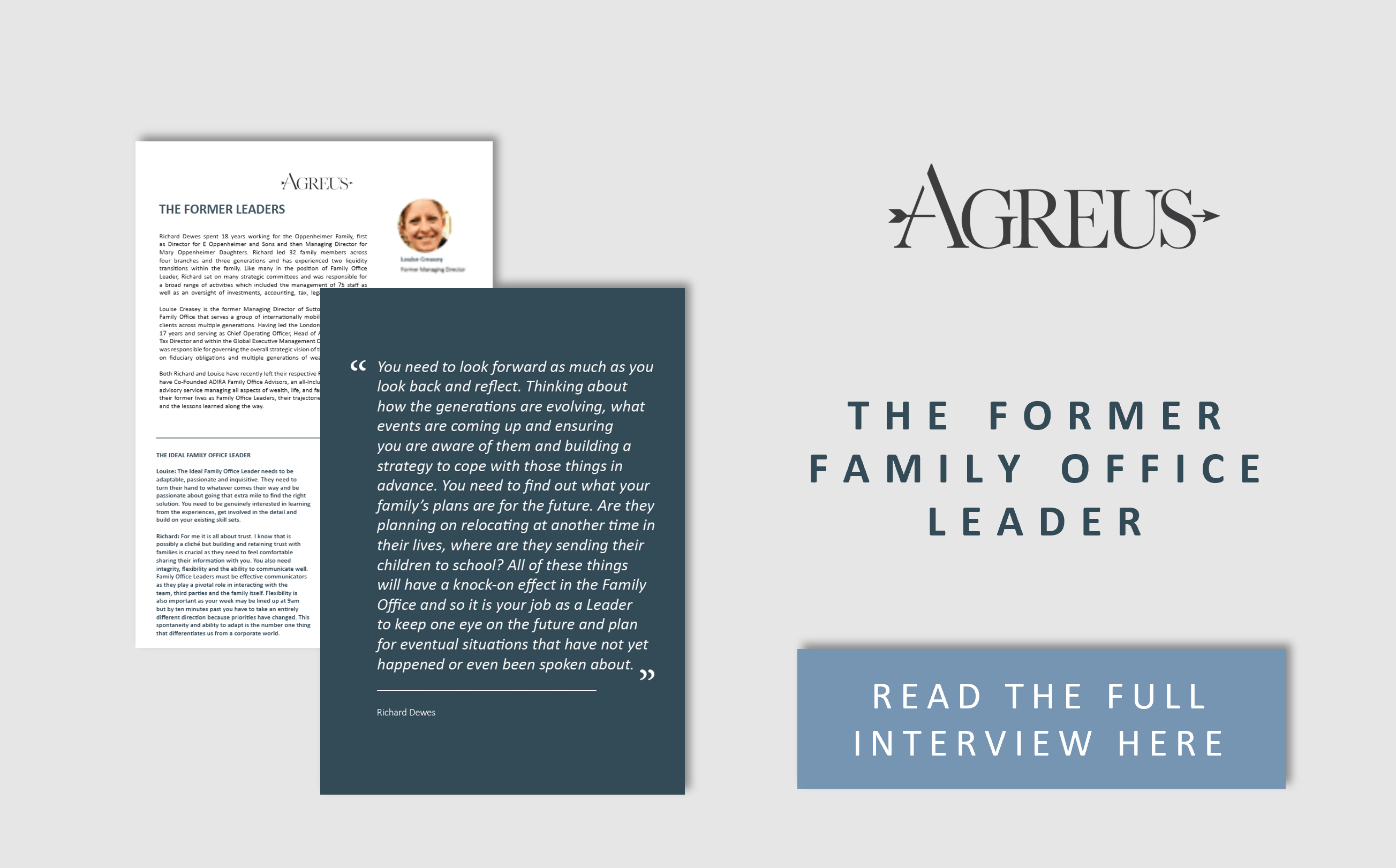
This is an extract from the Ideal Family Office Leader white paper. For the full report, please use the download form on this page.
Louise Creasey is the former Managing Director of Sutton Place, a Single Family Office that serves a group of internationally mobile high net worth clients across multiple generations. Having led the London Family Office for 17 years and serving as Chief Operating Officer, Head of Advisory Services, Tax Director and within the Global Executive Management Committee, Louise was responsible for governing the overall strategic vision of the family, focused on fiduciary obligations and multiple generations of wealth preservation. Louise recently left her Family Office to Co-Found ADIRA Family Office Advisors, an all-Inclusive independent advisory service managing all aspects of wealth, life and family. Here she discusses her former life as Family Office Leader, her journey to the top spot and the lessons learned along the way.
THE IDEAL FAMILY OFFICE LEADER
The Ideal Family Office Leader needs to be adaptable, passionate and inquisitive. They need to turn their hand to whatever comes their way and be passionate about going that extra mile to find the right solution. You need to be genuinely interested in learning from the experiences, get involved in the detail and build on your existing skill sets.
TRAJECTORIES TO THE TOP
The structure and purpose of the Family Office often dictates the background of the person you have in that leadership position. You can have your classic investment office which focuses exclusively on investment management or a Family Office which manages everything from accounting, legal, treasury, tax and insurance.
My background in tax was quite unusual as I specialised in both Private Client Tax and Corporate Tax which meant as well as dealing with individual client and family issues, I would also be involved with their businesses which offered an overall commercial awareness and understanding of various business operations. This made it easier to evolve into other areas of the Family Office and as I already had a degree in law and a background in insurance, it was easier for me to transition into and understand several different facets of the Family Office environment. Notwithstanding that, you need to continually evolve.
EVOLVING AS A LEADER
As a Leader you must make sure that you keep up to date in terms of rules, regulations and markets – having as big a network as you can possibly imagine in terms of specialists and relationships with other Family Offices to allow you to information share and learn. When I first joined the world of Family Offices, they were very closed and didn’t really share practices. We established an alliance in 2005 with others to share ideas, structures and best practice and while at the time it was unheard of, today it is common for Family Offices to compare ideas and speak to the few other people who can relate to what you do.
PRACTICE MAKES PERFECT
The biggest difference for me coming from a corporate environment is the fact that you could shout across the floor to your team and many others in specialist teams, with a question and there was such a large technical database that there was always someone with the experience who could answer or who may have seen the issue before. In Practice you are surrounded by support while Family Offices on the other hand can be very lonely places. You have a great responsibility on your shoulders without having the huge support network to match.
Aside from the adjustment of size and the support network, I think people can also have a false impression of Family Offices as being these easy workplaces, where there are no stresses or burdens and it is not like that at all. Of course, they can be intimate and friendly environments but the role of the Family Office Leader comes with a lot of responsibility and pressures. It can be a 24/7, 365 days a year role and requires dedication and professionalism like any professional services environment, if not more.
The adjustment may be tougher for some coming from the corporate world, especially those who are accustomed to big organisations with the provision of many divisions, technical and administrative support teams, known pay rises and promotion timescales to go up the corporate ladder. In my 17 years with the Family Office, titles did not change. Of course, pay scales change but you prove your worth by your work, your added value, your passion for successful outcomes and that is how you progress. It is something leaders need to think incredibly carefully about, particularly personality fit and the part it plays in leadership working alongside the family and the Family Office team itself.
LEARNING CURVES
My biggest learning curve was the sheer volume of subject matters and the issues at play at any one time. You can go from relocating someone around the world in terms of citizenship, visas, tax positions and houses to negotiating office leases or buying a plane. The biggest learning curve was moulding my skill-set to the various different facets of the business and as everything in Family Offices is always on an instant timetable, it can for the most part be consistently juggling balls mid-air. My biggest learning curve was to be nimble and switch from one subject matter, technical issue or project to another.
DOING THINGS DIFFERENTLY
The role of Family Office Leader is full-on and very much full-time and in the world we live in, where emails and communications software sit in all of our pockets, everyone expects everything instantly. If I would have done anything differently, I would have set more boundaries, slowed things down, said no more and measured expectations more often. The more you give to a family in terms of quality advice in short timeframes, the more they will come to expect.
SUCCESSION PLANNING
Most heads stay within their Family Office for a very long time and the reasons are obvious as you build that trust and longevity and grow so much personal knowledge that the challenge of replacement and change is extremely high. The relationships are also deep with regards to trust and respect that it is also very hard to leave.
It is also a family conversation to be had. Do you stick with one long-term leader who can be trusted unconditionally or, do you bring in new blood?
LOOKING OUTSIDE THE FAMILY
My Family Office was multiple family members across more than one branch. A combination of family, internal officers and independent advisers that sit on a Board to review the overall position brings multiple skill-sets and viewpoints for consideration. For a Family Office Leader position, it is often impossible to fill from the family due to the confidentiality required across the various family members in the service provision. I think for Family Offices who manage the assets of one primary family member, then it can work. That is not however to say the family if multiple in number, shouldn’t play any role. They should absolutely always have oversight and control as that is crucial. It is vital they sit on the Board or specific committees whether investment or philanthropy and play a pivotal decision-making role.
After-all it’s their family office and their mandate as to what the Family Office is and the services it provides. Coming up with a governance plan and board composition so all family members feel included and have a voice in the family office strategy is key.
For access to all of our statistics and interviews around the topic of The Ideal Family Office Leader, download the full report.