


Most Family Offices know who will lead them next, but not everyone is ready for the handover. That is the central finding of Bank of America’s latest release, Building For Generations, a white paper surveying 355 U.S. Family Office decision-makers, with offices up to $5B in assets under management (AUM).
The report echoes something we observed in our day-to-day: succession planning is well underway, but succession readiness is not. While 83% of Family Offices have identified a successor, only 27% have a trust distribution policy or guiding principles in place. The consequences are already visible: a quarter of those surveyed have been through a leadership transition in the last decade, yet only 37% of them said their incoming principal was very prepared for the role. For an industry built around preserving wealth across generations, this really is a sobering figure. Here, we look at what closes the gap: governance, an eye on the next generation’s priorities, and the talent to hold it all together.
Governance is the bridge
When asked whether governance is a powerful tool for alignment and harmony in their Family Offices:
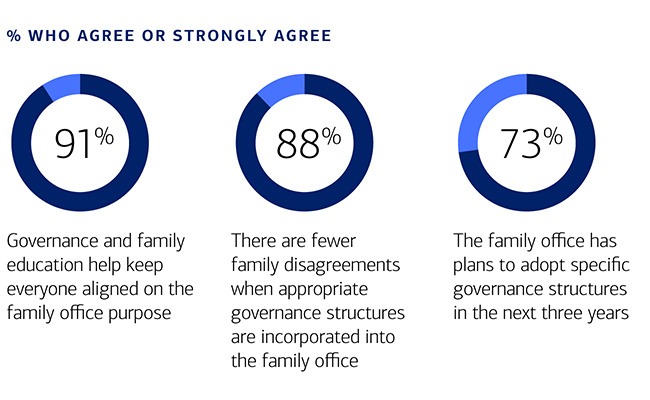
(Dark blue=Agree, light blue=Disagree)
Unsurprisingly, family dynamics are quoted as the top governance challenge (45%), ahead of the complexity of shared assets (37%). Governance rarely falters because of the commercial side of things; it falters because of relationships, a challenge unique to the Family Office world and exactly what governance is designed to address. The report’s findings are encouraging: 88% say family disagreements are less frequent when appropriate structures are in place, 90% already use three or more governance elements, and 73% plan to adopt more.
However, the picture is less complete when it comes to succession. Naming a successor is a decision, but preparing one is a process, and families appear to understand this: 91% agree that governance and family education help keep families aligned, yet only 40% have a formal family education programme. Without that preparation, a successor steps into a role whose boundaries only they and the outgoing principal understand.
Formality also tends to follow scale. As families grow, with more assets, more family members and households, and more employees, policies are written down, family councils and committees become more common, and technology is used to greater effect. But we believe that Family Offices that wait for complexity to force the issue will end up building structures under pressure, often mid-transition, when emotions are highest and time is shortest. The best-prepared families put governance in place while things are calm.
That is easier said than done, and from our own experience, capacity, not intent, is often the real challenge. Family Office teams are lean, and education, governance, and next-generation development can fall to people whose days are already full. Good governance also demands facilitation skills, legal and tax awareness, and sensitivity to family dynamics, rarely all held by one person. For many families, this may be the prompt to bring in a dedicated governance specialist, whether as a hire or an advisory relationship. And importantly, once governance is in place, it needs regular review: a constitution written for the first generation may not suit the family as it grows and their needs and complexity evolve, and a policy that sits in a drawer for decades is not governance.
A new generation, new priorities
The report also hints at how the next generation may reshape the Family Offices they inherit. Four in 10 Family Offices now hold sports investments, and those with at least one Gen Z or Millennial principal are the most likely to own sports teams or sports-related assets. This is something we covered earlier this year, when we wrote about the growing appetite for sports among Family Offices, and it is encouraging to see the report’s data point the same way. That said, the traditional playbook is not being abandoned: private equity remains the cornerstone of alternative allocations, with 59% of respondents planning to increase their exposure over the next three years. Still, as priorities evolve, so will the skills a Family Office needs, which is worth planning for alongside the transition itself.
Talent: the biggest cost and the biggest lever
Family Offices spend around 44% of their budgets on personnel, compared with 23% on fees such as investment and legal costs and roughly 15% on technology and systems. Evidently, people are both the largest cost and the largest source of value, which means the talent strategy matters as much as the governance framework it supports.
With so much of the budget tied to people, pay cannot be set on instinct or on what was paid five years ago. Rigorous benchmarking practices let principals confirm that packages are both competitive enough to attract and retain the key employees. That matters in a market where Family Offices compete not only with each other but with private equity firms, hedge funds, private banks and Multi-Family Offices for the same experienced professionals. Without a clear view of how base salary, bonus and long-term incentives compare, a Family Office risks losing strong candidates at offer stage or watching key team members leave for better-structured packages.
Another very interesting finding for us was that the report found that 31% of Family Offices share employees with the family’s operating business. Of course, this keeps overheads down and allows the family to draw on existing expertise, but it brings its own difficulties. A shared employee is effectively doing two jobs, with two sets of stakeholders, two reporting lines, and a level of trust and discretion that is hard to quantify. We have seen this way too often when we are doing our compensation consulting practices with clients, where the employee’s pay reflects only the operating business side, while the Family Office work is treated as an informal add-on. Over time, this breeds dissatisfaction and leaves the family exposed if that person leaves.
A better approach is to look beyond a standard benchmark for either role and ask what it would cost to replace the person entirely: two separate hires, lost institutional knowledge and family relationships, and a lengthy and costly search. Seen that way, fair pay for dual-role employees costs far less than the alternative. Whatever the staffing model, benchmarking against reliable, Family Office-specific data turns the largest line in the budget into a deliberate strategic investment rather than a reactive cost.
Which brings us back to succession. Most families have answered the question of who comes next. The more important question is whether that person, and the Family Office around them, will be ready. Distribution policies, family education and governance structures are the foundations, but they only work if the right people are in place to build and sustain them, and are rewarded in a way that keeps them there. We believe the families that start now will be the ones whose transitions succeed.
Ready or not, preparation starts now. Whether it is a governance framework that holds up under pressure, a hire who fits both the Family Office and the family, or a pay structure that keeps key people through a transition, Agreus works with Family Offices on all three, informed by 16+ years of proprietary data.