

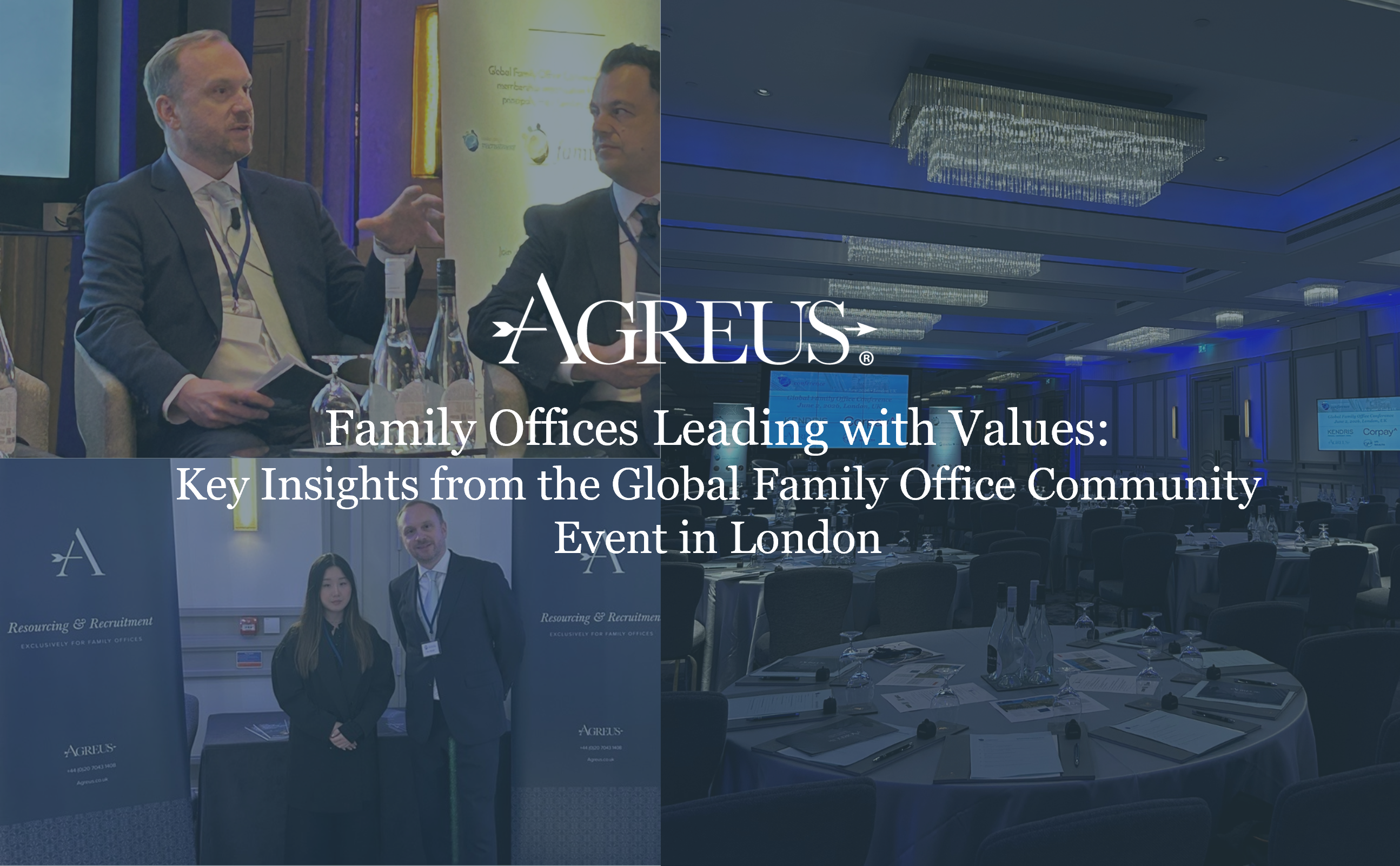
The Global Family Office Community (GFOC) Conference in Mayfair, London, held in early June, brought together a distinguished group of Family Office principals, executives, advisors, and industry leaders for a day centred around one defining theme: “Leading with Values, Shaping the Future.”
Opening the conference, GFOC Founder and host Vahe Vartanian reflected on the remarkable evolution of the Family Office landscape, as he highlighted, “not too long ago, no one was really talking about Family Offices unless you were running one, today, everyone is talking about them.”, noting that they have now become a central focus of global wealth discussions.
Against a backdrop of geopolitical uncertainty, economic volatility, technological transformation, and generational transition, the conference brought together a series of speakers and panel discussions exploring how Family Offices are adapting their structures, investment strategies, governance models, and leadership approaches to meet the evolving demands of modern wealth stewardship.
Representing Agreus, Co-Founder Paul Westall was invited to join a panel discussion during the day, contributing insights into the operational and strategic shifts currently shaping the global Family Office landscape.
Relationships, Trust and “Invisible Capital”
The day opened with a thought-provoking session titled “The Invisible Capital: Why Our Relationships Shape Every Decision We Make.”
The discussion highlighted the often underestimated role that human relationships play in decision making, positioning them as a critical but sometimes invisible force behind both successful and unsuccessful outcomes. Even decisions that appear purely rational are often deeply influenced by trust, alignment, and interpersonal dynamics.
The session emphasised that the cost of neglecting relationships can be brutal, especially in the Family Office space, reinforcing the importance of maintaining existing connections while also continuing to build new ones across the ecosystem.
One of the recurring themes throughout the day was that successful Family Offices increasingly recognise their most valuable assets are not solely financial. Trust, communication, shared values, and access to strong networks continue to define long-term resilience and effective decision-making.
Family Office Trends and Opportunities
The morning panel featuring Paul Westall and three other experts explored some of the most significant opportunities and challenges currently facing Family Offices.
Discussion topics included:
- The increasing professionalisation of Family Offices
- Talent acquisition and leadership succession
- Operational complexity and governance evolution
- The rise of next-generation involvement
- Private market investment opportunities
- Technology adoption and digital transformation
- The growing demand for specialist expertise
- Long-term value creation through purpose-driven leadership
Drawing on Agreus' recent white paper collaborations with KPMG Private Enterprise and UBS Family Office Solutions, Paul shared insights into the trends he is seeing across the global Family Office landscape.
A key theme was the growing recognition of formal governance structures and their role in supporting long-term success. Paul highlighted the increasing importance of incorporating external expertise within investment committees, noting that independent perspectives can strengthen oversight, improve decision-making, and help Family Offices navigate increasingly complex investment environments.
He also emphasised the value of having a structured Investment Policy Statement (IPS), which provides clarity around objectives, risk appetite, governance, and decision-making processes. As Family Offices continue to professionalise, frameworks such as these are becoming increasingly important in supporting consistency and accountability.
Another area Paul discussed was talent retention. As Family Offices compete for highly specialised professionals, he noted the growing importance of clear performance measures, ROI benchmarks, and long-term incentive plans (LTIPs) to attract and retain key employees.
The conversation also turned to Artificial Intelligence and its growing adoption within Family Offices. While Paul is seeing increasing interest in AI tools across the sector, he believes their primary role today is to enhance operational efficiency, improve reporting capabilities, and support lean teams rather than replace people altogether. As with many technological developments, the greatest value currently lies in enabling better decision-making and helping Family Offices operate more effectively.
Beyond governance and technology, other panellists shared perspectives on emerging investment opportunities created by geopolitical shifts and global competition. Sectors highlighted included defence and space technologies, semiconductors and microelectronics, artificial intelligence, autonomy, and energy security. Clean energy and sustainable infrastructure were recurring themes throughout the day, reflecting both long-term investment potential and broader societal priorities.
Generational wealth transfer and succession planning also featured prominently in the discussion. One panellist highlighted the continued growth of women's wealth through both vertical and horizontal wealth transfer and stressed the importance of involving women in decision-making processes early. She noted that succession planning is often not designed with future female wealth holders in mind, despite the increasingly important role women play within Family Offices and family enterprises. Another panellist agreed, observing that women frequently thrive when given opportunities to participate more actively in leadership and governance discussions.
Private market investing was another area of focus. One panellist expressed strong conviction in the opportunities available through private markets, arguing that many of the most compelling investment opportunities remain outside public markets. At the same time, he cautioned Family Offices to approach co-investment opportunities carefully and ensure they have sufficient in-house expertise to evaluate opportunities effectively. His advice to Family Offices was simple but powerful: "Think ahead and work backwards".
Maximising Long-Term Value Creation
One of the most engaging sessions of the day focused on value creation, strategic positioning, long-term planning, and building enduring success.
Drawing on his experience climbing Mount Everest, the speaker used powerful analogies to illustrate the importance of preparation, resilience, and clarity of purpose when pursuing ambitious goals.
Just as a successful Everest expedition requires careful planning long before reaching the mountain, sustainable value creation requires a clear vision, disciplined execution, and alignment between strategy and objectives.
The session encouraged attendees to think beyond short-term outcomes and focus instead on defining long-term goals, understanding what success looks like, and creating a roadmap to achieve it.
For Family Offices in particular, the message resonated strongly: long-term success is rarely accidental. It is built through careful preparation, thoughtful decision-making, and a commitment to aligning actions with long-term family objectives and values.
Industrial Strategy and the Broader Economic Landscape
In this session, the speaker delivered an insightful overview of the UK's industrial strategy and the broader economic landscape shaping investment and growth opportunities.
The speaker highlighted a number of exciting opportunities for Family Offices based in the UK. The UK continues to work closely with the United States and has secured favourable tariff arrangements. The speaker also referenced ongoing discussions regarding a comprehensive trade agreement with the Gulf region, which could further enhance international trade.
As the European Union remains the UK's largest trading partner, the speaker emphasised that significant opportunities continue to exist across Europe. The UK is currently engaged in a range of discussions with EU counterparts, and the speaker expressed considerable optimism about the future of UK-EU economic relations.
Another key factor contributing to the UK's attractiveness, of course, is its tax environment, which was described as highly supportive of investment growth.
Clean energy and renewable technologies were also identified as areas of huge potential. The speaker noted that the UK has the world's second-largest offshore wind capacity, positioning it as a leader in the energy transition. In addition, the government is seeking to develop the Oxford-Cambridge (OxCam) Corridor into the UK's equivalent of Silicon Valley. This initiative aims to create the country's largest technology and innovation hub, generating significant opportunities for investment, research, and entrepreneurship.
An additional takeaway related to the UK's space strategy. When asked about the sector's future direction, the speaker explained that the UK's focus is on dual-use technologies, innovations and infrastructure that have applications not only in the space industry but also across sectors such as life sciences, defence, and advanced manufacturing. To support the scaling of these technologies, the UK has established partnerships with like-minded countries, including the United States and Japan.
Overall, this session provided valuable perspectives on innovation, international trade, investment priorities, and the important role that private capital continues to play in supporting long-term economic development.
Regulation, Mobility and a Global Perspective
As Family Offices continue to operate on an increasingly international scale, discussions surrounding regulation, cross-border planning, and global mobility remain highly relevant.
The speaker shared observations on how global mobility trends are evolving in response to geopolitical developments. She noted that political and economic uncertainty in certain regions has influenced the movement of individuals and capital, with some families and investors relocating from the Middle East and other markets. At the same time, jurisdictions such as Singapore have attracted growing attention.
Despite these shifts, the speaker emphasised that the UK remains a highly attractive hub for Family Offices and professionals. Its political stability, well-established legal and regulatory framework, favourable taxation, deep financial markets, and access to global talent continue to make it a compelling location for international families and investors.
Artificial Intelligence: Reality, Risks and Opportunities
One of the most anticipated and engaging discussions of the day focused on the hot topic – Artificial Intelligence (AI) and its growing influence across industries, investment strategies, operations, and decision-making.
The panel brought together experts from neuroscience, robotics, communications, and technology strategy, providing a comprehensive perspective on both the opportunities and challenges presented by AI.
Key themes included:
- The practical implementation of AI technologies
- Ethical considerations and governance frameworks
- AI’s impact on investment analysis and operational efficiency
- Cybersecurity and risk management
- The balance between human judgement and automation
- The long-term implications of AI for private capital and family offices
A significant part of the discussion centred on the risks associated with AI-generated content. Panelists warned that the rapid proliferation of deepfakes, manipulated images, misinformation, and “fake news” has the potential to cause substantial reputational and financial damage to businesses and families alike. While such content remains relatively detectable today, experts cautioned that distinguishing fact from fiction may become increasingly difficult over the coming years, urging families to stay vigilant.
Questions were also raised about the reliability of current AI systems. One expert noted that, despite their impressive capabilities, large language models are fundamentally designed to predict patterns rather than truly reason or understand information. While AI can generate convincing responses and identify patterns in conversations, it is prone to making assumptions and should not be viewed as a substitute for critical thinking and expert judgement.
The panel also touched on the challenge of coding morality and ethics into AI systems. Experts highlighted the difficulty of programming ethical decision-making, particularly in situations where the distinction between right and wrong is nuanced or context-dependent. Another topic of debate was the growing excitement surrounding humanoid robotics. One panelist cautioned against what he described as a potential “humanoid robot bubble”, arguing that investor enthusiasm and capital allocation may not reflect the technology’s practical applications.
When asked about the risks of using generative AI, one expert remarked: “Don’t yell at the engineer. They can create the technology, but it is up to you how you choose to use it.” The panel broadly agreed that individuals and organisations must understand both when to engage with AI and when human judgement should take charge. They also emphasised the continued importance of specialist expertise within Family Offices, encouraging families to carefully assess their talent requirements rather than assuming technology alone can fill gaps.
The impact of AI on junior roles was another hot topic in the media at the moment. While automation is expected to reshape certain entry-level responsibilities, the panel advised against short-term cost-cutting measures that come at the expense of developing future talent. Given that generative AI technologies are still evolving, experts advised that investing in high-potential young professionals remains essential for building long-term capability and resilience.
Leading Across Generations
The closing panel, “Families: Leading with Values, Shaping the Future,” brought the conversation back to the human and generational dimensions of family office leadership. It brought together four speakers representing a diverse range of backgrounds, including second-, third-, and twelfth-generation family members, as well as a spouse who married into a fifth-generation family; the session offered a unique opportunity to explore how leadership, responsibility, and legacy evolve across generations.
A central theme of the discussion was the challenge of balancing expectations from predecessors with the desire to find their individual path. One panellist spoke candidly about navigating the expectations of previous generations while also pursuing personal ambitions and creating their own identity within the family enterprise and Family Offices. As one panellist reminded the audience, “You are not your wealth,” encouraging younger generations to develop their own sense of purpose and identity as they prepare to take on future leadership responsibilities.
All speakers also highlighted philanthropy as a key area of focus for them. They expressed a strong commitment to using wealth as a force for positive change, emphasising that financial success carries responsibilities to contribute meaningfully to society. As one panellist noted, “With wealth comes responsibility.”
There is also a broad consensus on the importance of preparing future leaders early. Several speakers stressed that successful intergenerational transitions do not happen by chance but require deliberate planning and exposure from a young age. One panellist shared how she had worked across multiple Family Offices and ensured she obtained the qualifications and experience necessary to earn credibility in her role. She also recalled being brought into meetings with financial managers by her mother from an early age, which helped her develop both knowledge and valuable professional relationships. Other speakers echoed this view, noting that exposing younger family members to the operations of the Family Office and business early on is crucial in building both interest and capability.
The conversation also explored a less frequently discussed perspective: that of individuals who marry into families with generational wealth. One panellist reflected on the challenges of integrating into both the family and the operating business as a spouse, describing the process as complex and requiring intentional effort from all parties involved. She emphasised the importance of establishing clear expectations through well-structured agreements, including prenuptial arrangements where appropriate, and creating a thoughtful framework to support integration into the family enterprise. Above all, she stressed the need for open communication and a willingness to engage in difficult conversations to prevent misunderstandings and conflict.
Communication was a recurring theme throughout the session. Speakers highlighted its importance not only within families, but also between family members and their trusted advisers. In the often private and highly personal world of Family Offices, strong relationships and honest dialogue were seen as essential foundations for long-term success.
The discussion provided a fitting conclusion to a day focused not only on financial capital, but also on leadership, responsibility, relationship dynamics, and long-term vision. It served as a reminder that the enduring success of family enterprises as well as Family Offices depends as much on people, values, and relationships as it does on investment performance and wealth preservation.
Final Words
Lastly, we would like to thank Vahe Vartanian and the Global Family Office Community team for hosting a highly engaging and insightful event, as well as all speakers and attendees who contributed to the dialogue. As the Family Office landscape continues to evolve, events such as this play an important role in fostering collaboration, sharing expertise, and shaping the future direction of the industry.
Beyond the panel discussions and formal sessions, one of the most valuable aspects of the event was the opportunity to reconnect with familiar faces across the family office community while also building new relationships and conversations with people from across the industry. We look forward to continuing these conversations and reconnecting with many of those we met at future events in the months ahead.